Exploring Factors relating to College Prestige, Cost, and Size: How Do They Affect Graduate Salaries 10 Years Down the Line?
The choice of what college to attend is often one of the most important decisions a student will ever make during their educational career. Many factors, including how they are perceived (i.e. are they a "household name"?) and what their return on investment may look like play a crucial role in making such decisions. But what do they actually look like in a visual format?

Median Graduate Earnings of the Top 200 Colleges
This bar chart displays the median graduate earnings for each one of the Top 200 institutions in the United States. They have also been color coded by type: Public/state schools and Private, nonprofit schools. Hovering over each bar reveals the school's ranking as well as its location. We can see that schools with blue bars (representing private schools) tend to extend further out than orange bars (public schools), indicating, that private schools are, in general, more likely to produce graduates who will end up making higher salaries. However, this is only a very direct graph - deeper and more nuanced insights can be found in the other graphs.
Exploring Direct Correlations between Factors and Earnings
Some factors can be directly visualized - especially ones with quantitative, continuous data such as how much a school charges to go there and how renowned, popular lists (such as U.S. News, Forbes, and more) rank colleges across a variety of different criteria.
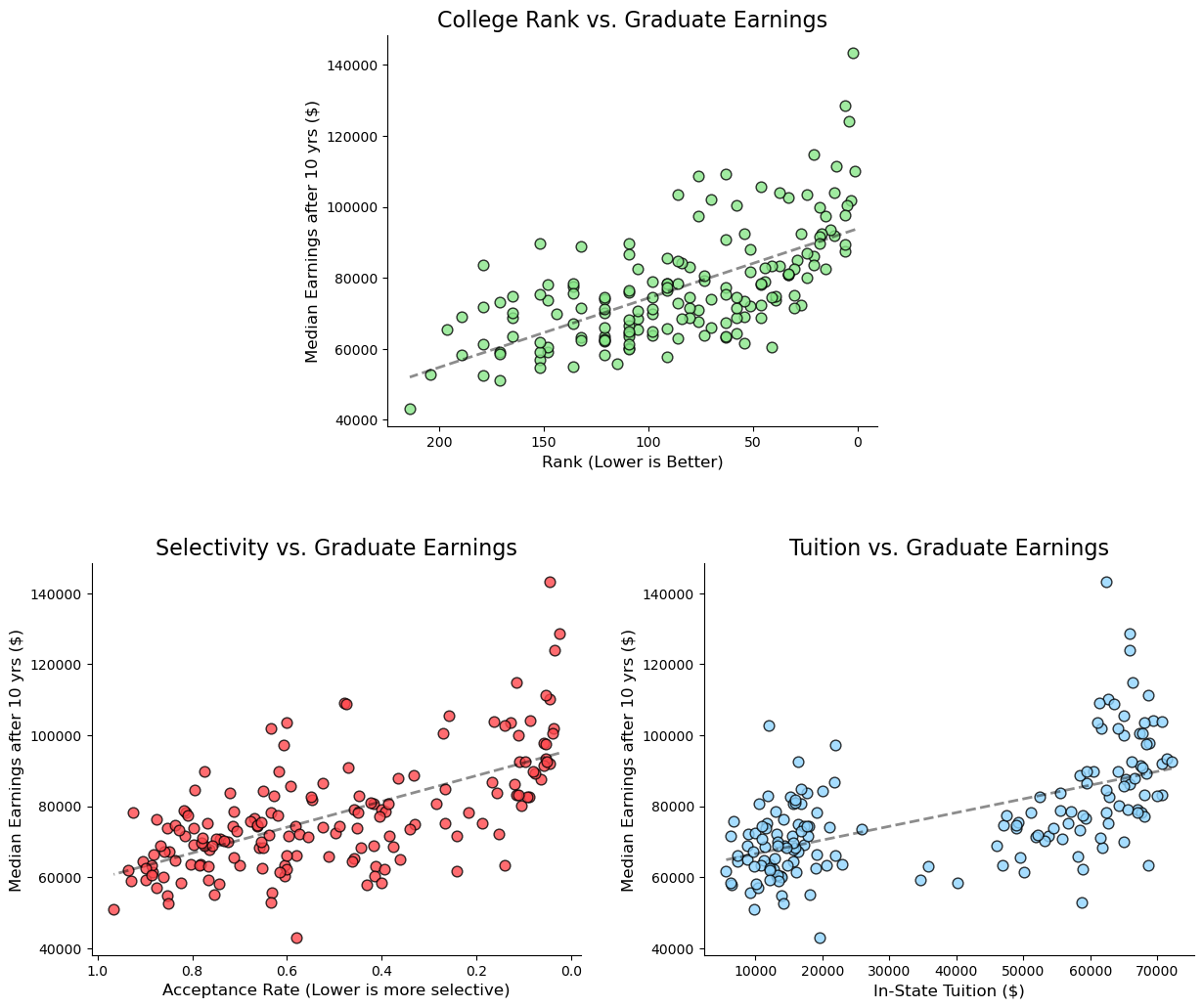
Scatterplots of Ranking, Acceptance Rate, and Tuition
These three factors are often considered most prominently when students are seeking a college to attend. Acceptance rate is often synonymous with both ranking and perceived prestige, as the most productive and elite schools often have the lowest, single-digit acceptance rates. Tuition (especially in-state tuition for public schools) is also a leading monetary factor in a student's choice of school - many students have to decide whether attending a more expensive, elite school would be worth it in the long run, compared to a cheaper, but potentially less pretigious university.
About the dataset
Our dataset takes information from two different sources and merges it together into one comprehensive medium. The U.S. College Scorecard, run by the Department of Education, provides data on a large amount of variables such as tuition rates, Median Graduate Debt, and most importantly, Median Earnings for Graduates across time. This was combined with data from the U.S. News College Rankings List, a premier resource that provides comprehensive numerical rankings for American universities up to 2025.